Her Family Demanded Her Fortune for Their Kids, So She Decided to Cut Them Off
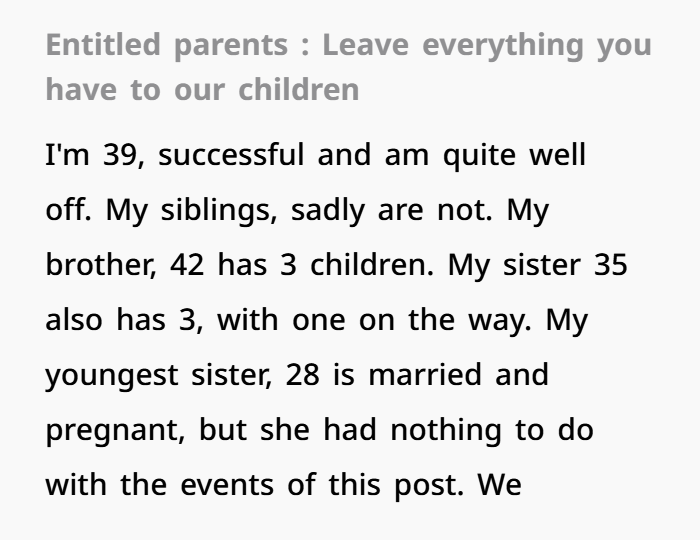
A 39-year-old woman found herself facing an uncomfortable question about family and money.
After years of helping her relatives financially, her siblings began making plans for money that wasn’t theirs.
The woman had built a successful career and become financially independent. Unlike her siblings, she had decided not to have children.
She was happy with that choice.
She enjoyed her life with her boyfriend and pets and had no plans to become a parent. Her siblings, meanwhile, were raising larger families.
Their different choices didn’t stop her from helping her family.
She had supported relatives financially for years. She even paid for her parents to live in a comfortable assisted living facility.
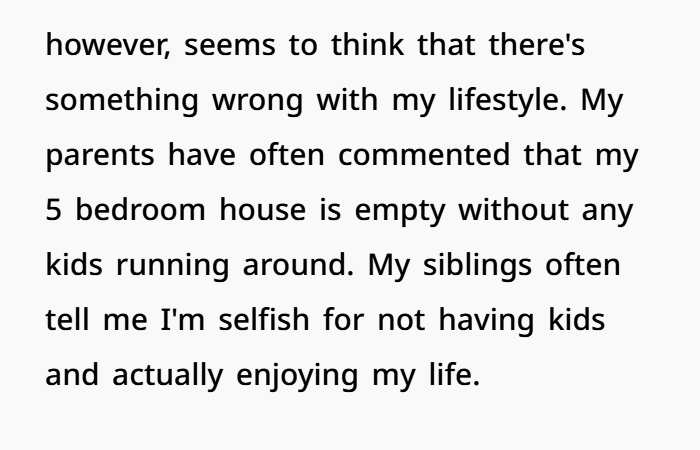
Still, she said some relatives criticized her for being childfree.
They viewed her lifestyle as selfish, despite the financial support she had provided.
Then a family visit turned the tension into a much bigger dispute.
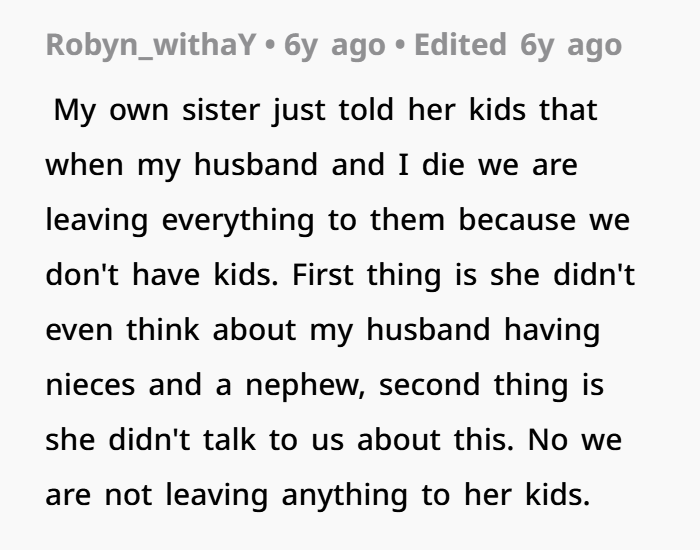
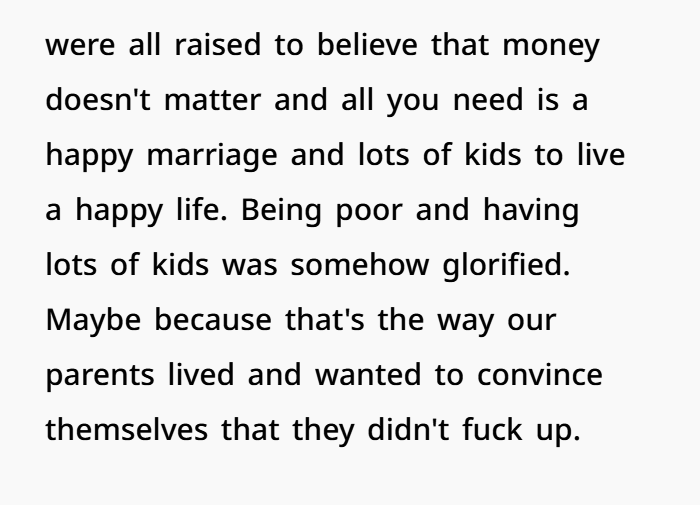
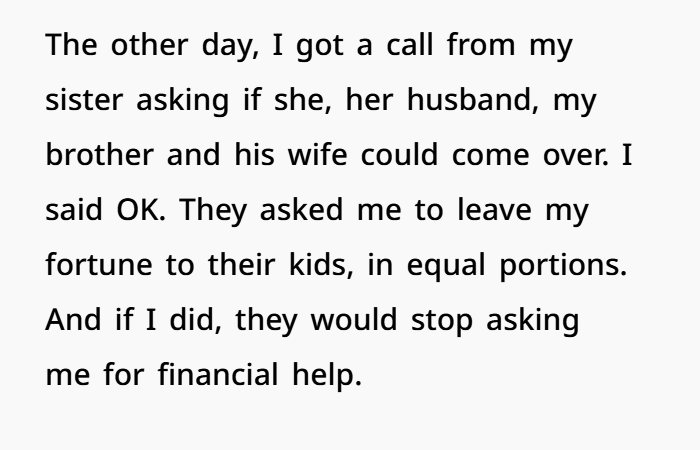
Her brother and sister brought up her inheritance plans. They wanted her to leave her wealth to their children.
Their reasoning was simple: She didn’t have children of her own, so they believed their kids should eventually receive her money.
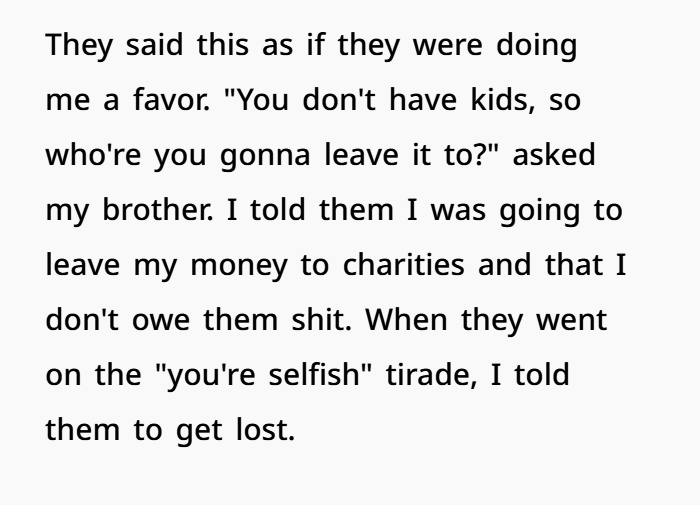
The woman strongly disagreed.
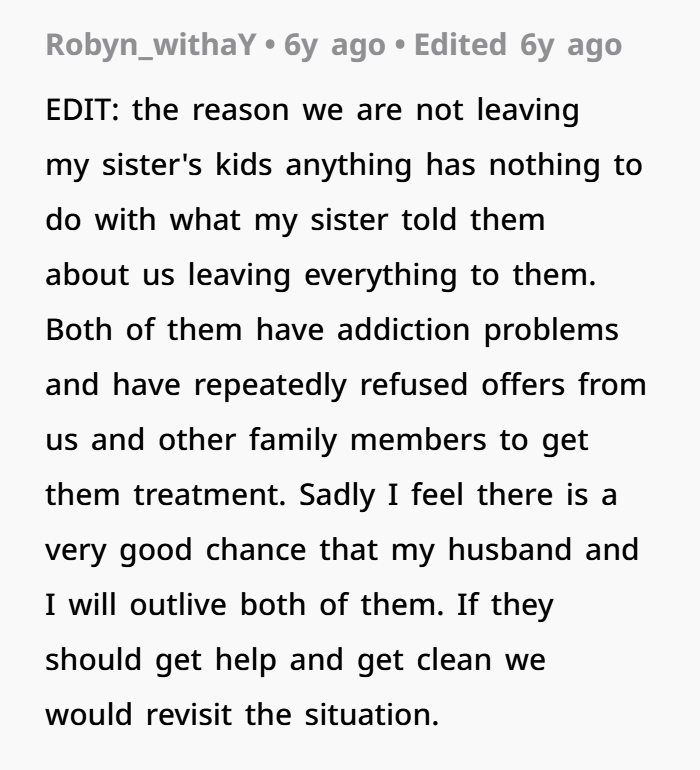
She had already thought about what she wanted to happen to her estate. Instead of automatically passing everything to relatives, she planned to leave much of her wealth to charities and causes she cared about.
That decision didn’t go over well.
Her siblings apparently felt their children should benefit from the fortune she had built. She saw things very differently.
Advertisement – Continue Reading Below
The money belonged to her.
She had earned it, saved it, and supported relatives with it for years. Being childfree didn’t mean other family members automatically gained a claim to her estate.
The disagreement soon became part of a larger family conflict.
Another dispute involved her parents’ assisted living arrangements.
The woman said disagreements arose over rules involving her pets. She felt her safety concerns and requests weren’t being taken seriously.
Eventually, she changed the arrangement she had been paying for.
That decision upset her relatives even more.
What started as a disagreement about inheritance had now grown into a wider fight about money, boundaries, and family obligations.
The situation also raised an uncomfortable question.
How much should someone be expected to give simply because they have more money than other members of their family?
Her siblings had children to support. She didn’t. But she didn’t believe that difference gave them the right to decide what happened to the wealth she had spent years building.
For her, being generous was a choice rather than an obligation.
And after feeling judged for her lifestyle while also being expected to fund other people’s futures, she began drawing much firmer boundaries.
Her story sparked debate about inheritance, family expectations, and financial independence.
Some questioned whether every decision she made was necessary. Others believed the larger principle was simple: No relative is automatically entitled to someone else’s money.
Having no children doesn’t make a person’s savings family property.
And helping relatives in the past doesn’t mean they get to decide how much help they receive in the future.
For this woman, the conflict eventually became about more than money.
It became about deciding where generosity ended and entitlement began.













Money can make family problems much harder to handle.
On the surface, this story seems to be about siblings who chose different lives. Some chose marriage and children. One woman focused on her career, financial security, and a childfree life.
Neither path is automatically better.
The problem began when relatives stopped respecting those differences.
She Was Judged for Choosing a Different Life
According to the story, the woman often felt judged because she didn’t have children.
Some relatives considered her lifestyle selfish. Yet she had built a career, gained financial freedom, and created a life she enjoyed.
That alone wouldn’t have caused such a strong reaction from readers.
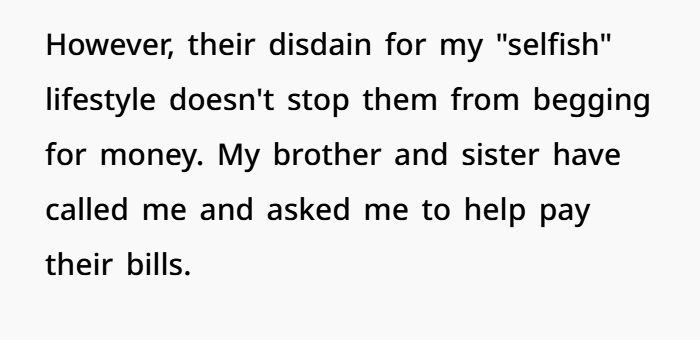
What stood out was that some of the same relatives judging her also accepted her financial help.
Many people saw a clear contradiction.
They criticized the choices that helped her build wealth while also expecting to benefit from that wealth.
Different Lives Come With Different Costs
Raising children can be expensive.
Housing, food, childcare, education, and other costs can place pressure on parents. A sibling without those expenses may have more freedom to save or invest.
That difference can sometimes create tension.
But having fewer expenses doesn’t make someone’s extra money available to the rest of the family.
The woman had made her own choices and accepted the results. Her siblings had done the same.
Each path came with different rewards and costs.
She Had Already Given Her Family a Lot
Another important detail was how much financial help she had already provided.
She reportedly supported relatives and paid for her parents’ assisted living care.
Many readers considered that generous.
But repeated help can sometimes change how people view it.
What begins as a gift can slowly become an expectation. Instead of asking whether someone wants to help, relatives may begin assuming that person should help.
That appears to have been a major source of tension here.
Her financial success had started to feel less like her achievement and more like a family resource.
The Inheritance Request Crossed a Boundary
The conflict became much more serious when her siblings discussed her estate.
They reportedly wanted their children included because she had no children of her own.
For many readers, that request crossed a line.
Inheritance isn’t something relatives automatically earn.
A person can leave money to siblings, nieces, nephews, friends, charities, or anyone else they choose.
Being childfree doesn’t change that.
The woman wanted much of her estate to support charities and causes she cared about. That reflected her own values and plans for the money she had earned.
Her siblings were free to dislike that decision.
But the final choice remained hers.
Generosity Is Different From Obligation
This leads to the central question in the story.
Does having more money mean someone owes more to their relatives?
Helping family can be a generous and meaningful choice. But generosity loses much of its meaning when it becomes a demand.
The woman had already provided years of financial support.
That didn’t create a permanent duty to keep paying.
Nor did it give relatives the right to decide what should happen to her wealth after her death.
A gift is still a gift, even when the person giving it can easily afford it.
The Dispute Over Her Parents Was More Complicated
The situation involving her parents added another difficult layer.
She changed their assisted living arrangement after disagreements involving her pets and concerns about safety.
Some people may view that response as severe.
But from her point of view, the dispute was part of a larger pattern. She felt her wishes and boundaries weren’t being respected.
The pets themselves may not have been the main issue.
Instead, the disagreement seemed to represent years of frustration that had finally reached a breaking point.
Family conflicts often develop this way.
One event causes the final argument, but the anger behind it has been building much longer.
Not Every Family Relationship Was Broken
Her relationship with her younger sister also added useful context.
She described getting along with her and respecting her choices.
That suggests her frustration wasn’t simply directed at people who married or had children.
The deeper issue appeared to be how certain relatives treated her.
She could respect choices different from her own. What she wanted in return was the same respect.
Financial Boundaries Matter
Money can create unusual roles within families.
The person who earns the most may become the one everyone calls during an emergency. Over time, helping can begin to feel like a job they never agreed to take.
That’s why financial boundaries matter.
Someone can love their family without paying every bill.
They can help their parents without funding their siblings.
They can care about nieces and nephews without leaving them an inheritance.
And they can stop giving when financial help begins causing resentment.
Different Choices Still Deserve Respect
There is no single correct way to build a meaningful life.
Some people want children and large families. Others value careers, travel, pets, charity, financial freedom, or other goals.
Choosing one path doesn’t make another less worthy.
The woman wasn’t responsible for funding her siblings’ choices simply because her own life left her with more money.
Her relatives weren’t wrong for hoping she might help their children.
The problem came when hope became expectation.
In the end, the conflict was about much more than inheritance.
It was about whether generosity should be freely given or treated as something relatives are owed.
Healthy family relationships need respect on both sides.
And sometimes, the hardest boundary to set comes after years of being the person who always said yes.